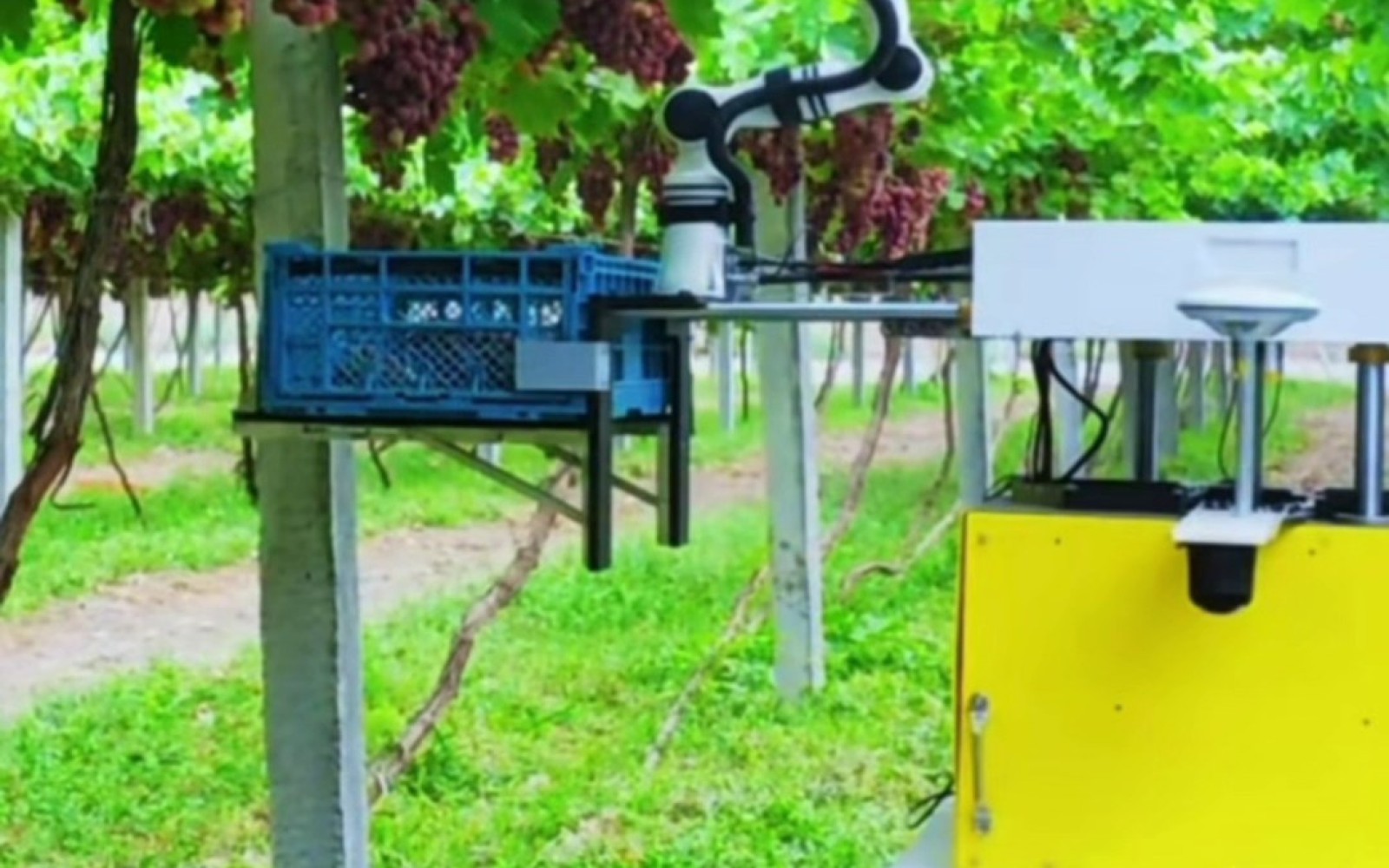
On 17 September 2026, Hong Kong newspaper Ming Pao published in its Hong Kong News section “Robots pick fruit to fill the agricultural labour gap” (《機器人採水果填補農業勞動力缺口》). It describes a mainland mix of hard-to-find jobs and hard-to-fill farm posts, with young people preferring delivery and ride-hailing to manufacturing and agriculture, and full-time farm employment down by about 100 million over ten years. Local startup MEINONG ROBOT CO., LIMITED is building fruit-picking robots for that gap and has entered the Xinjiang market.
According to the report, founder Li Deyong cited National Bureau of Statistics figures: full-time workers in agriculture, forestry, animal husbandry and fishery fell from about 270 million in 2015 to about 170 million in 2025. Ministry of Agriculture and Rural Affairs data put the group’s average age at about 53.1 in 2024, with those under 35 under 5%—too few new entrants to offset retirement and career change.
He began preparing the company in 2022, combining AI and industrial robotics, and chose fruit picking because staple-crop harvest is already highly mechanised, while fruit bruises and skin damage easily hurt appearance and price—so picking robots are harder, including in Europe and the US.
The line splits into vine-fruit X-Picker 2 (two arms) and tree-fruit X-Picker 4 (four arms), with prototypes in June and November last year. Ming Pao says X-Picker 2 is about 1.4 m × 0.8 m × 1.5 m for grapes, honeydew melon and passion fruit under trellis and hedge systems, picking a cluster or fruit in about 10 seconds, or about 15,000 jin in a 10-hour day; X-Picker 4 is about 2 m × 1.8 m × 1.9 m for apples, pears, citrus, mangoes and avocados, about 12,000 jin a day. Fruit damage is under 5% on both. List prices are about US$100,000 and US$150,000–200,000 depending on volume. A battery swap about every four hours allows continuous work.
By the end of July this year, more than ten X-Picker 2 units had been sold to farms in Xinjiang for grape picking. The X-Picker 2 design is largely frozen, with software still being tweaked; small numbers of X-Picker 4 have been shipped to Australian farms for trial. The report also notes the 2nd runner-up finish at Rocket Fuel during LEAP East in July. Li estimates combined sales of 20-plus units by year-end, 100–200 next year toward break-even, and operating profit on both models by 2028.
Near term the company will focus on markets with the highest picker wages: Xinjiang in mainland China (about RMB 350–450 a day) and Australia (about A$30 an hour). Ming Pao cites about 50 firms worldwide working on fruit-picking robots, fewer than 10 on the mainland. A Japanese company wanted a white-label order; MEINONG would accept dual branding only.
Primary source: Ming Pao Hong Kong News, “Robots pick fruit to fill the agricultural labour gap”.